
Machine safety · CE compliance · Risk assessment · SISTEMA · Retrofit
Industrial machine guarding: safeguarding and CE compliance
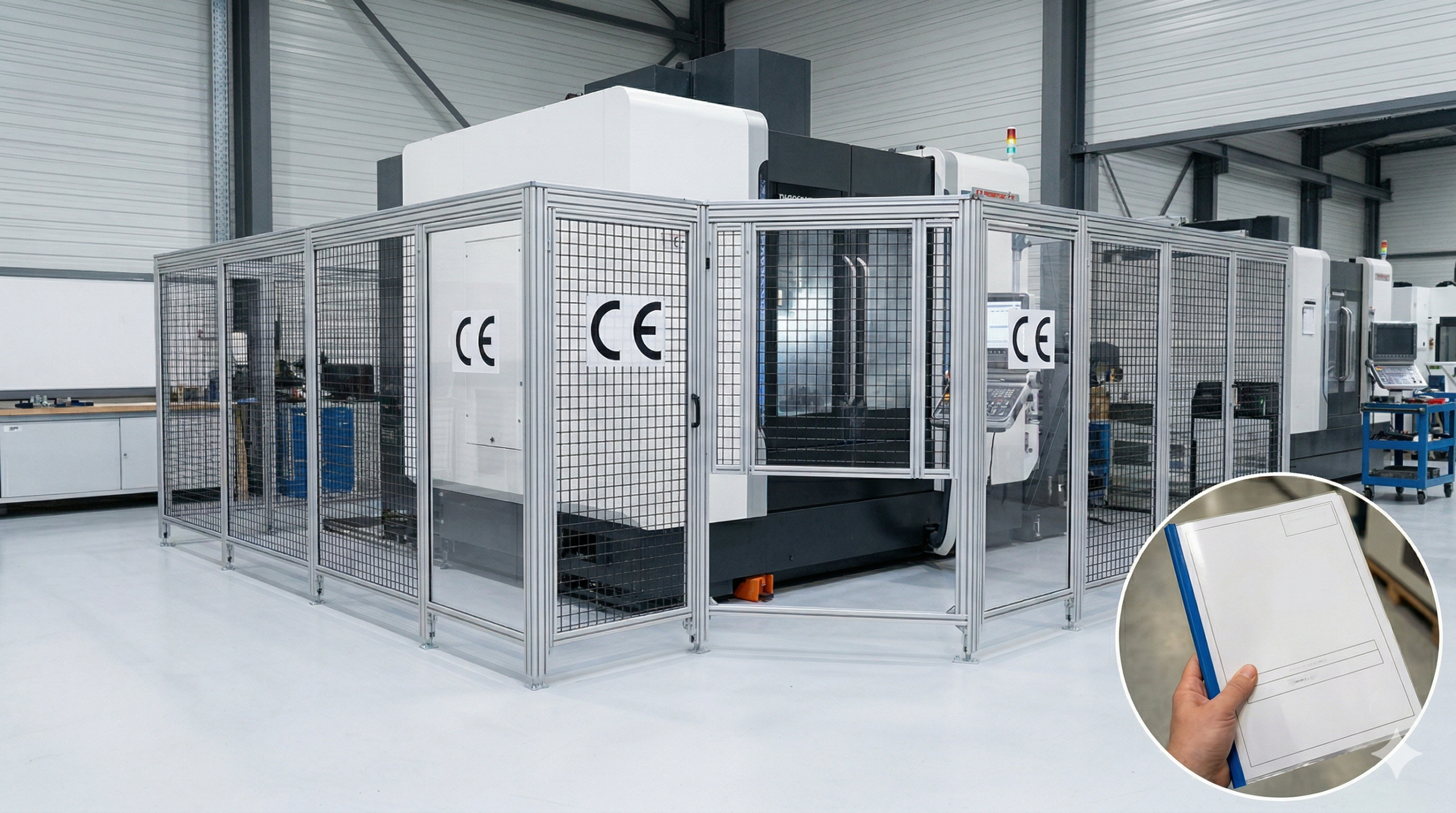
Machine guarding is a project in its own right, not just a matter of bolting on panels. It engages your liability as an employer and determines whether your machine complies with the Machinery Directive 2006/42/EC. Our mechanical design office, north of Nantes, manages your projects from A to Z: risk assessment, design, manufacturing, wiring, PLC, SISTEMA study and CE technical file. A single point of contact, with documented and defensible compliance.
Why machine guarding is a project, not a product
A guard physically protects an area. Machine guarding ensures that this protection is effective, safe and compliant — which involves far more than manufacturing a guard. Carried out without method, machine guarding can even create new hazards (a door that shears, an unsafeguarded actuator, an insufficient safety chain) while giving a false impression of compliance.
Our approach is based on the Machinery Directive 2006/42/EC and the EN ISO 12100, EN ISO 13849 and EN ISO 13857 standards. It covers five inseparable requirements, from risk assessment to quantified proof of the safety level achieved.
Documented risk assessment
To identify every hazard and justify each protective measure.
Calculated safety distances
So that openings, residual gaps and door movements do not themselves create shearing or crushing hazards.
Certified safety chain
Functional and certified, it ensures the machine stops within a fraction of a second in the event of unplanned access.
Quantified proof of the level achieved
Through the SISTEMA study, to meet the requirements of the EN ISO 13849 standard.
Complete CE technical file
It engages your liability and must be kept for 10 years.
Our machine guarding approach
Eight structured steps, from risk assessment to the CE technical file — each backed by the standard that governs it.
- 01
Risk assessment · EN ISO 12100
Identification of hazards (crushing, shearing, drawing-in, ejection), estimation of the initial risk, then definition of the technical measures that drive all protection choices.
- 02
Safety distances · EN ISO 13857
Reach distances through openings and anti-shear distances around moving doors, integrated and verified from the CAD design stage onward.
- 03
Design & selection of guards
Polycarbonate panels on aluminum profiles, metal mesh or sheet metal depending on the environment. Modeling in SolidWorks and verification of all residual gaps before manufacturing.
- 04
Doors and actuators
Manual interlocked doors, powered doors synchronized to the cycle or guillotine doors with an unattached cylinder, designed for practicality and intrinsic safety.
- 05
Safety chain & PILZ relays
Devices connected to a redundant PILZ monitoring system (PNOZ X, PNOZmulti 2, PSS 4000) that cuts power or commands an STO stop within a fraction of a second.
- 06
PLC modification
Adaptation of the program (Siemens TIA Portal / Step 7, Schneider Unity Pro, Allen-Bradley Studio 5000, Codesys) and safety interface via PROFIsafe, CIP Safety or hardwired connection.
- 07
SISTEMA validation · EN ISO 13849
Calculation of the performance level achieved (typically PL c or PL d) with the IFA's SISTEMA software: architecture, MTTFd, diagnostic coverage and anti-CCF measures.
- 08
Manufacturing, installation & CE file
Workshop manufacturing, on-site wiring, trigger tests and stopping-time measurement, then compilation of the entire technical file and the EC declaration of conformity.
Critical point · EN ISO 13857 & 13856-2
Doors, actuators and safety distances
Access doors are the most sensitive points of a machine guarding project. The gap between a moving door and a fixed structure must be either less than 4 mm (too narrow for a finger) or greater than 25 mm; in between, there is a proven shearing hazard. For crushing, the gap must exceed 120 mm for the arm or 500 mm for the whole body.
On guillotine doors, we systematically adopt the unattached-cylinder principle: the rod is not fixed to the door, which descends by gravity and closes naturally in the event of an air supply cut — a position that is safe by nature. Calibrated gas-spring balancers keep the descent slow and steady; on fast descents, a safety edge (EN ISO 13856-2) immediately reverses the movement at the slightest contact.
Our mechanical design office
Safety chain · PLC · SISTEMA
Safety that stops fast and can be proven
The safety chain links all protective devices — cam, magnetic or tamper-proof RFID door switches, emergency stops, light curtains, safety mats — to a redundant monitoring system. In the event of a door opening or a fault, the PILZ relay opens the power contactors and/or sends an STO (Safe Torque Off) command to the drives: the machine stops within a fraction of a second.
Integrating machine guarding onto an existing machine almost always involves adapting the PLC: creating or modifying the blocks that manage the operating modes (automatic, manual, maintenance) and interfacing with the safety controller. The EN ISO 13849 standard then requires demonstrating, with figures to back it up, that each safety function achieves the performance level required by the risk assessment. We carry out this validation with the SISTEMA software (IFA); its report is mandatory in the CE technical file.
Machine safety, SISTEMA and compliance
Compliance upgrade
Retrofit: guarding an existing machine
Adding compliant guarding to a machine already in service is one of our specialties. The process is often triggered by a labor inspectorate order, a workplace accident, a change in the machine's use or the desire to make the most of existing assets.
The key question is to determine whether the modification is "substantial" within the meaning of the Machinery Directive — in which case it may trigger a full compliance upgrade — or whether it simply reduces an existing risk. We analyze your situation on a case-by-case basis to advise you on the exact scope of your obligations.
Electrical and mechanical retrofitEN ISO 10218-1 & 10218-2
Guarding of robotic cells
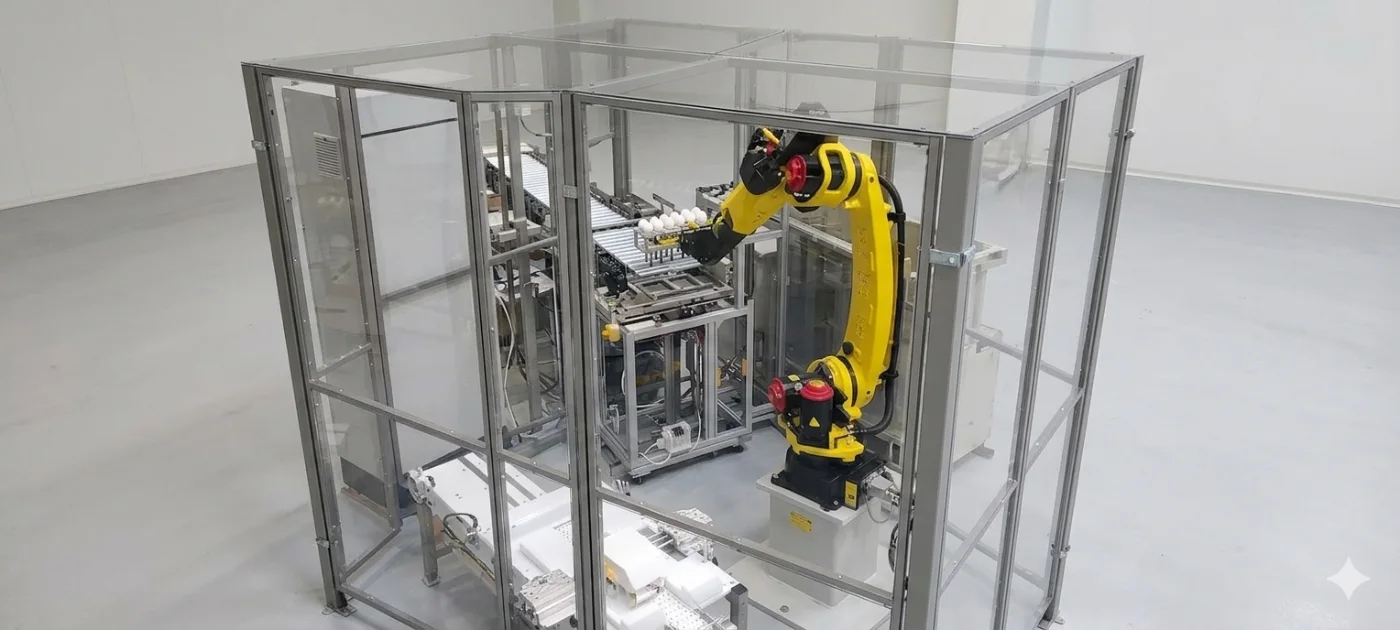
Robotic cells are subject to specific requirements. We carry out the calculation of the exclusion zone, the sizing of the polycarbonate panels according to the robot's kinetic energy, the design of maintenance access points with tamper-proof RFID sensors and the interface with the robot controller (FANUC, KUKA, ABB, Stäubli, Universal Robots).
Frequently asked questions about machine guarding
What is the difference between a guard and machine guarding?
A guard is a physical protective device: it mechanically isolates a hazardous area. Machine guarding is the complete project: risk assessment, guard design, safety chain, SISTEMA study, PLC modification and CE file. You can install a guard without carrying out complete machine guarding, but you cannot carry out machine guarding without designing the right guard.
Does guarding an existing machine require a full CE compliance upgrade?
Not systematically. If the guarding constitutes a substantial modification of the machine (change in the risk level, addition of a new hazardous energy source), it may trigger a full compliance upgrade. If it simply reduces an existing risk without profoundly modifying the machine, the process is lighter. We analyze your situation on a case-by-case basis.
What is the SISTEMA study and why is it mandatory?
SISTEMA is an IFA software that calculates the performance level (PL) achieved by a safety function according to EN ISO 13849. It validates that the "door opening = machine stop" function achieves the PL required by the risk assessment, taking into account the redundant architecture, the MTTFd of the components, the diagnostic coverage and the anti-CCF measures. The SISTEMA report is mandatory in the CE technical file.
Why use an unattached cylinder on a guillotine door?
On an unattached cylinder, the rod is not fixed to the door: the cylinder only serves to raise it, with the descent occurring by gravity. In the event of a power cut, the door closes naturally — this is an intrinsically safe position. Gas-spring balancers accompany this descent at a controlled speed to prevent any sudden fall.
Do you work on any type of PLC?
Yes: Siemens (TIA Portal, Step 7), Schneider Electric (Unity Pro, EcoStruxure), Allen-Bradley (Studio 5000), Codesys and others. We adapt the existing program to integrate the new safety functions without compromising production operation.
How long does a machine guarding project take?
For standard guarding with a simple safety chain: 4 to 10 weeks. For a complete retrofit with PLC modification, SISTEMA study and CE file: 3 to 4 months. We draw up a detailed schedule from the study phase onward.
Do you compile the complete CE technical file?
Yes. We compile the entire file: EN ISO 12100 risk assessment, SISTEMA report, electrical diagrams, instruction manual and EC declaration of conformity. This file is essential for CE marking and must be kept for 10 years.
A machine guarding or compliance project?
Tell us about your machine and your context (an inspection order, an accident, a change of use, making the most of your assets): our design office manages your machine guarding from risk assessment to the CE file.
Send us your specifications
