
Robotics
Robotic assembly cells and special robots
When a task is too repetitive, too precise or too fast for an operator, we hand it over to a robot. Assembly, bonding, screwdriving or laser marking: each cell is simulated, validated and then engineered around your product.
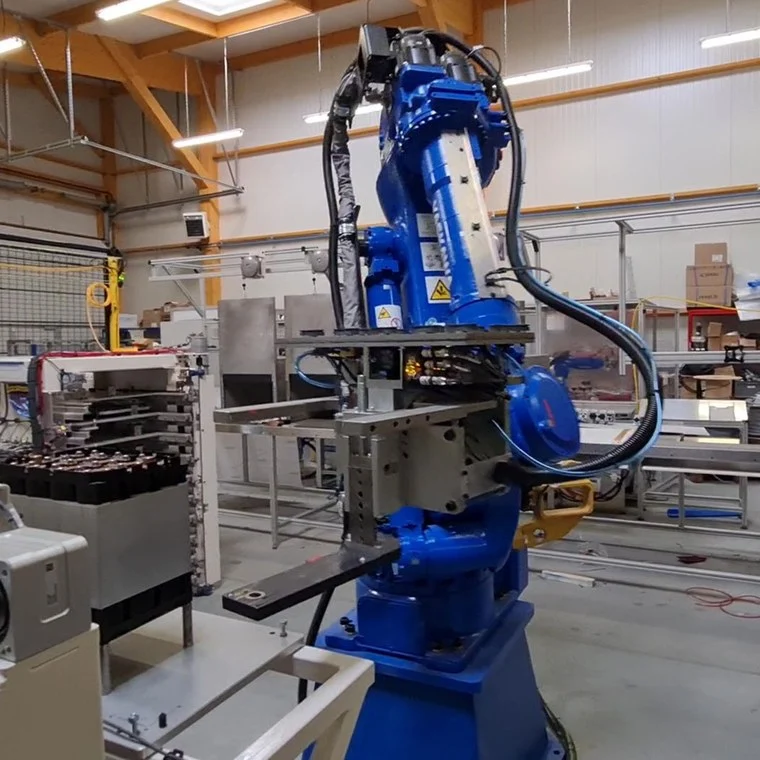
A robot at the heart of your assembly process
A robotic assembly cell combines one or more robots, dedicated grippers and tooling, a part-feeding system and, often, vision inspection. It carries out your operations with constant precision and throughput, with no fatigue or variability.
It is one of the applications within our industrial robotics business: our engineering office designs the layout, the grippers, the tooling, the guarding and the safety, and our robotics and automation engineers program and commission the cell, from study through to production.
The operations we robotize
Assembly
Picking and placing components, press-fitting, assembly of sub-assemblies and modules.
Bonding and dispensing
Robotic dispensing of adhesive or sealant, component bonding with presence checking.
Screwdriving
Robotic screwdriving with torque and angle control, and data traceability.
Laser marking and engraving
Engraving of part numbers, Datamatrix codes or logos, with read-back verification.
Integrated inspection
AI vision inspection with Deeper before and after the operation.
Learn more3D simulation and trajectory validation
Before manufacturing anything, we simulate the complete cell in 3D: robot, gripper, tooling, conveyors and guards. This step removes uncertainty and secures your investment.
- Verification of reachability for every pick and place point
- Validation of trajectories and detection of collisions with the environment
- Estimation of cycle time and selection of the best-suited robot
- Optimization of the layout and the floor-space footprint
- Offline preparation of the programming, for a shorter commissioning
The simulation also serves as a discussion tool: you validate how the cell works before it is built. It is used on all of our robotic cell projects.
Grippers engineered to measure
The gripper makes a cell reliable. We define it from your parts (material, geometry, fragility, tolerances) and design it in 3D before manufacturing and validating it in trials.
Pneumatic and electric grippers
Fingers machined to the shape of your parts, with sized stroke and clamping force.
Vacuum gripping
Suction cups and vacuum plates for flat parts, cartons, films or fragile parts.
Multi-reference
Multiple grippers or an automatic tool changer to handle several part references.
Grip checking
Presence, vacuum or vision sensors to verify every pick before the operation.
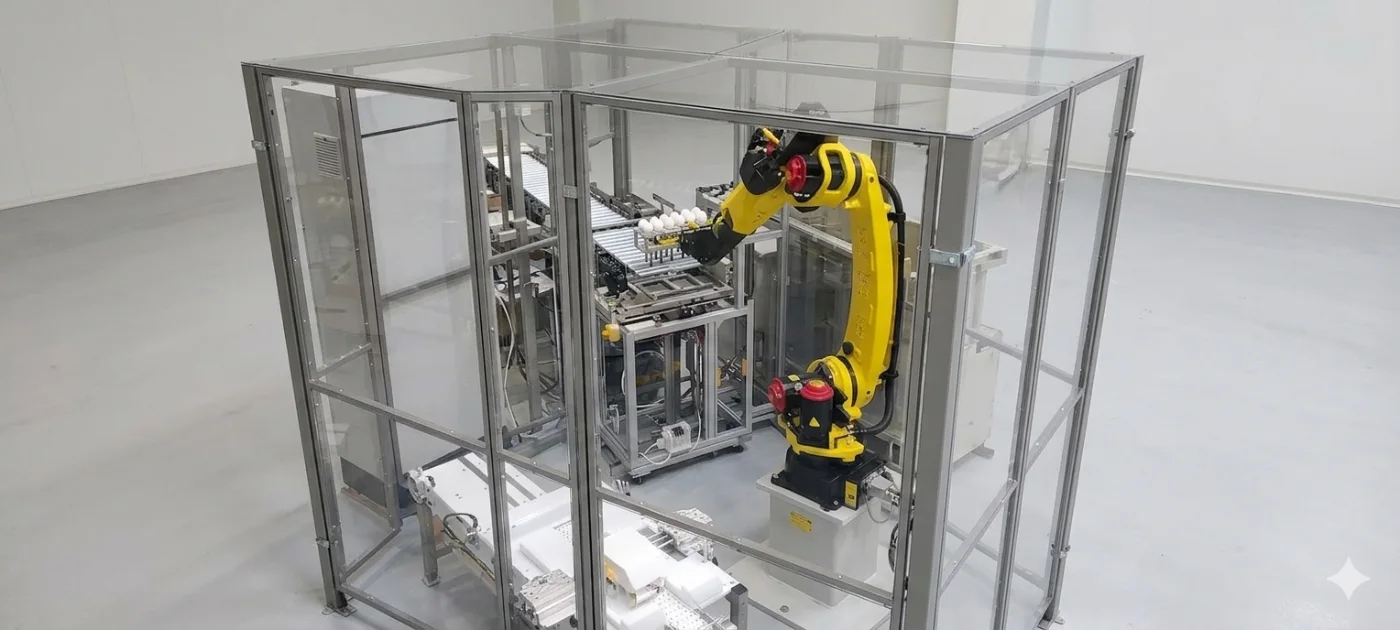
Part feeding, safety and integration
A high-performing cell also means parts presented in the right place and a cell that is safe for operators.
- Feeding by vibratory bowls, conveyors, indexing tables or magazines
- Guarding, doors and light curtains, laser scanners
- Risk assessment and validation of the performance level with SISTEMA
- Communication with your line and supervision system, operation traceability
To discover all of our robotic applications (palletizing, machine tending, depackers), see our industrial robot integration page.
A project in four steps
- 01
Feasibility study
Analysis of the product, throughput and tolerances, picking trials if needed.
- 02
3D simulation
Layout, trajectories, cycle time and robot selection validated with you.
- 03
Design and manufacturing
Grippers, tooling and guards designed in 3D, assembled in our workshops.
- 04
Programming and commissioning
Programming of the robot and the PLC, production trials, training.
Frequently asked questions
What is the difference between a robotic cell and a special machine?
A robotic cell is built around a standard, reprogrammable robot surrounded by dedicated tooling. A special machine uses dedicated motions. The cell is more flexible when your products change.
What is the 3D simulation for?
It validates reachability, trajectories, the absence of collisions and the cycle time before manufacturing. You know what the cell will do before you invest.
Do you design the grippers?
Yes, every gripper is designed by our engineering office for your parts: jaw grippers, suction cups, machined fingers, grip sensors, and a tool changer if there are several references.
Can a cobot be enough?
For moderate throughput and work alongside the operator, a cobot is often relevant. We guide you toward the solution suited to your throughput and your environment.
Can you integrate vision inspection?
Yes, we integrate conventional or AI vision inspection with Deeper, our software, to verify parts before and after the operation.
An assembly to robotize?
Send us your specifications or a few parts: we assess the feasibility, simulate the cell and propose a solution.
Send us your specifications
