Robotics · Mobile robots
Autonomous mobile robots (AMR) for internal logistics
Moving bins, carts or pallets between workstations, feeding lines, removing finished products: we integrate autonomous mobile robots and design the modules and exchange stations that make them useful.
Eliminate empty trips and hand-pushed carts
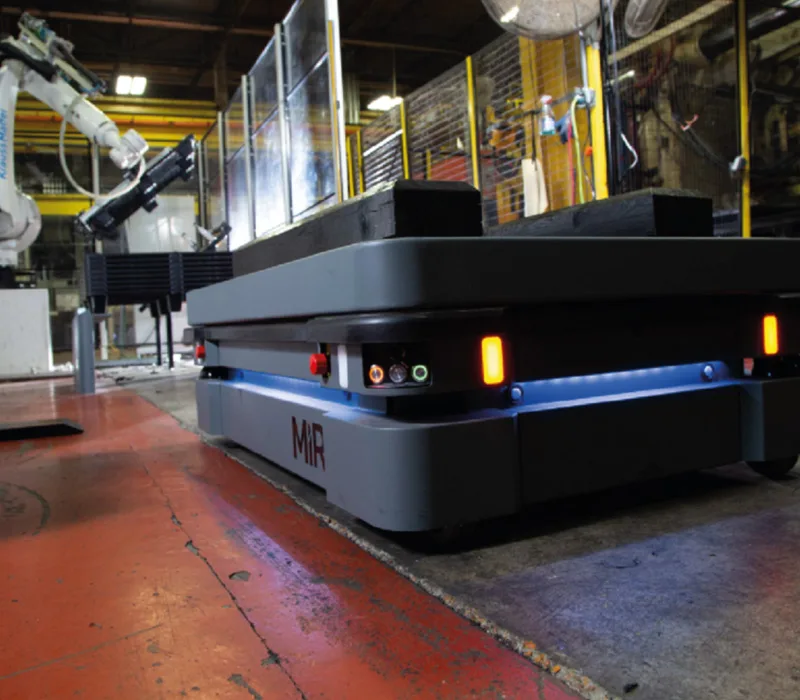
In many workshops, a significant share of operators' time goes into moving around: bringing in components, removing bins, pushing carts. An autonomous mobile robot (AMR) takes over these shuttle runs, consistently, while moving among people.
Unlike wire-guided AGVs, an AMR locates itself using a map of the workshop built with its laser scanners. It calculates its route and avoids obstacles. We integrate MiR and Omron robots in particular, and design everything around them that makes up a complete installation, in connection with our industrial robotics business.
What we automate with mobile robots
Bin transport
Shuttle runs of bins and cartons between stores, lines and shipping, with an onboard conveyor.
Cart towing
Automatic hitching and movement of existing carts.
Pallet transport
Fork or platform mobile robots for heavy loads.
Onboard cobot
Collaborative arm on a mobile robot to tend several machines.
Learn moreCleanrooms
Flows in controlled, pharmaceutical or cosmetic environments.
Autonomous navigation and safety
The mobile robot moves on its own, but its integration requires a real study of flows and safety.
- Mapping of the workshop, restricted zones, reduced-speed zones and preferred routes
- 360° laser scanners and 3D cameras to detect people and obstacles
- Risk assessment of routes and exchange stations in accordance with the ISO 3691-4 standard
- Door opening, elevator calling and zone passage through exchanged signals
- Fleet management and automatic recharging for continuous availability
What we bring around the robot
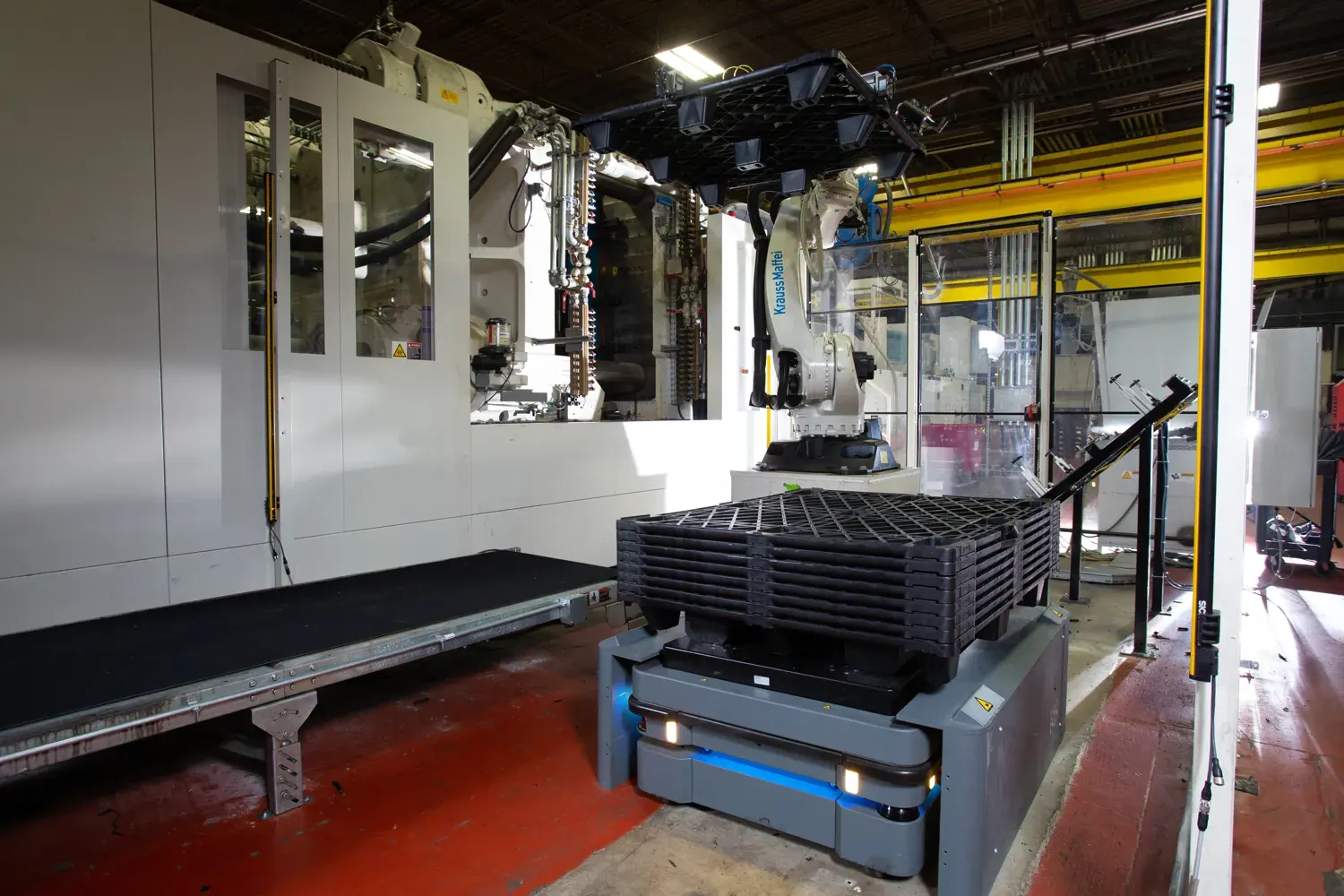
A mobile robot alone carries nothing useful. It is the modules, the exchange stations and the integration with machines that make the difference.
- Custom top modules: conveyor, hitching, platform, cobot
- Fixed exchange stations at end of line and in the store
- Call buttons, signals with the PLCs and the supervision system
- Connection to management systems to trigger missions
A mobile robot project in four steps
- 01
Flow study
Loads, frequencies, routes, crossings with people and vehicles.
- 02
Choice of robot and modules
Payload, top module, exchange stations and recharging.
- 03
Integration
Mapping, exchange stations, connection to lines, to the supervision system or to the ERP.
- 04
Commissioning
Production trials, zone adjustments, team training.
Frequently asked questions
What is the difference between an AMR and an AGV?
An AGV follows a physical path (wire, tape, reflectors) and stops in front of an obstacle. An AMR locates itself on a map of the workshop, calculates its route and avoids obstacles. It is easier to install and adapts to changes in layout.
Can a mobile robot move among operators?
Yes, it is designed for that: laser scanners, cameras and reduced-speed zones. The routes and the exchange stations are nonetheless subject to a risk assessment.
What loads can be transported?
From a few dozen kilograms for bins up to more than a ton for pallets, depending on the model and the module installed.
Do you design the top modules?
Yes, our design office designs the onboard conveyors, the hitching systems and the fixed exchange stations that allow the robot to load and unload on its own.
Can the robot communicate with our machines and our ERP?
Yes, missions can be triggered by a PLC, a call button, the supervision system or the ERP, and the robot can open doors or call an elevator.
Can mobile robots be used in a cleanroom?
Yes, suitable models exist. We study the flows, the materials and the cleaning with you for pharmaceutical or cosmetic environments.
Internal flows to automate?
Describe your routes, your loads and your frequencies to us: we will propose an architecture and a cost estimate.
Send us your specifications
