Mechanical design · Custom presses
Custom pneumatic press
Pneumatic, oleo-pneumatic and electric presses designed, calculated and manufactured to order for press-fitting, riveting, clinching and crimping. Engineering office north of Nantes, with CE compliance and SISTEMA analysis built in.
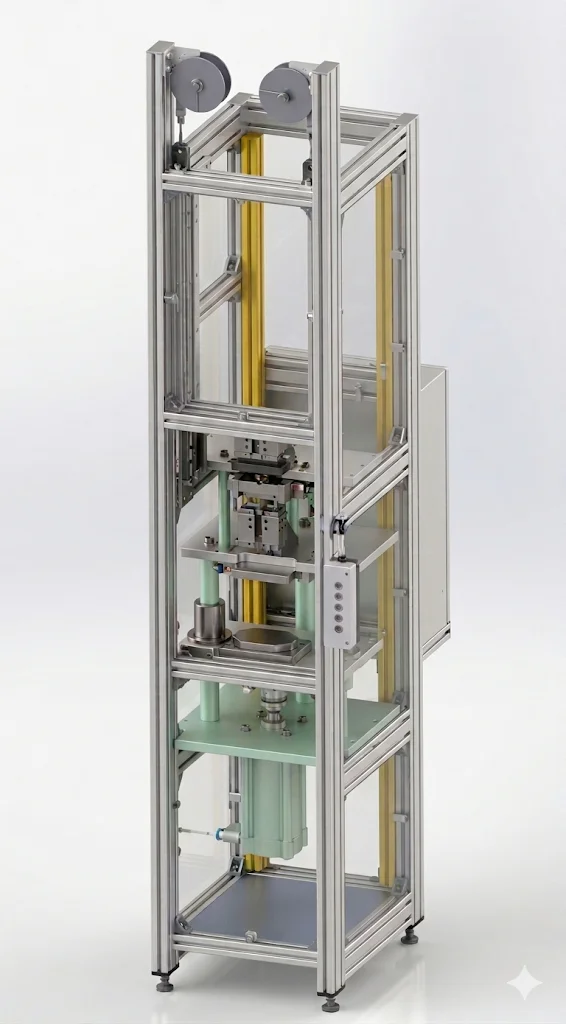
Presses sized for your operation
A custom press is designed around the operation to be performed: precision press-fitting of seals, bushings or bearings, riveting, clinching or crimping. We size the structure and the gooseneck frame, control deflection, select the actuators and integrate the safety components.
This is an application of our mechanical design office: 3D design, strength-of-materials calculation, manufacturing and commissioning in our workshops, then the CE file. Risk assessment, SISTEMA analysis and compliance are planned from the design stage onward.
Three press technologies
Pneumatic
Cylinder supplied with compressed air (6 to 8 bar), fast approach, up to ~50 kN. Ideal for press-fitting, snap-fitting, riveting and crimping.
Oleo-pneumatic
Pneumatic stage and hydraulic intensifier, from 20 kN to over 300 kN, constant force at end of stroke, with no dedicated hydraulic power unit.
Electric (servo press)
Servomotor and ball screw, from 1 kN to over 200 kN, position to ±0.01 mm, force/displacement traceability on every cycle, fluid-free for cleanrooms.
Which technology to choose?
| Criterion | Pneumatic | Oleo-pneumatic | Electric |
|---|---|---|---|
| Force range | Up to ~50 kN | 20 to 300+ kN | 1 to 200+ kN |
| Force control | Limited | Moderate | Excellent |
| Position accuracy | Low | Low to moderate | Very high, ±0.01 mm |
| Traceability | No | With sensor | Native |
| Power supply | Compressed air | Compressed air | Electricity |
| Cleanrooms | No | No | Yes |
| Cost | Low | Moderate | High |
Assembly processes
We design the tooling and the associated monitoring for each operation, with force and displacement sensors to validate every cycle.
- Press-fitting: assembly by interference fit (ISO), force sized according to the fit, friction and length.
- Riveting: solid or semi-tubular rivets, with punch, die and set tools designed and integrated.
- Clinching: joining without added fasteners through local deformation of several sheets in a single operation, according to thicknesses and grades.
- Crimping: securing end fittings, connectors or inserts by controlled deformation, with dedicated jaws and dies.
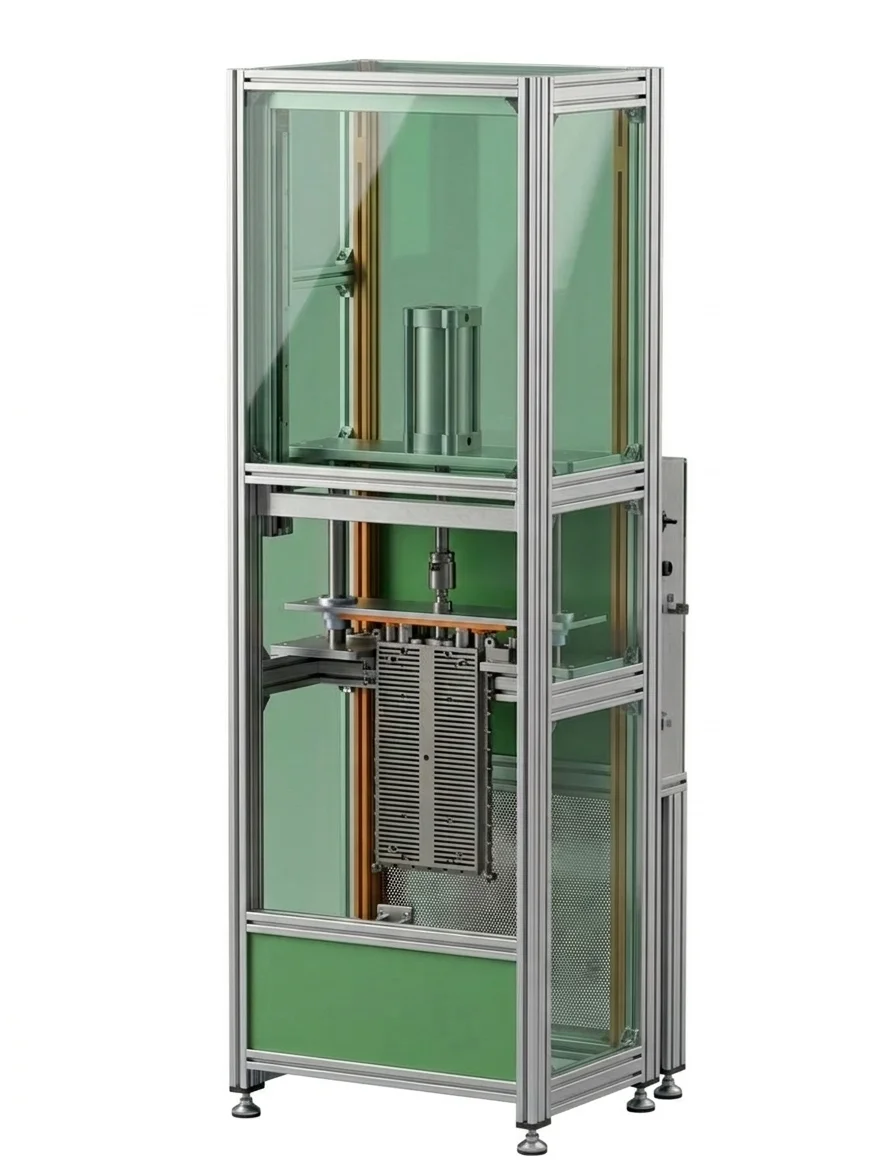
Gooseneck frame and deflection control
The gooseneck frame opens up lateral access to the part, unlike a closed gantry. Under load, it deforms elastically: this deflection moves the head away from the platen, misaligns the tool and distorts the reading of the sensor mounted on the rod.
- Target deformation below 0.1 mm in precision press-fitting
- S355 steel as standard, hardened steel or SG cast iron for very low deflection
- Systematic strength-of-materials calculation, finite element simulation if required
- Mechanical or electronic compensation, with the sensor placed as close as possible to the tool
Machine safety and CE compliance
Presses are among the machines that cause the most serious accidents. Safety is addressed from the design stage, in accordance with Machinery Directive 2006/42/EC.
- EN ISO 12100 risk assessment and required performance level (often PL d, category 3)
- SISTEMA analysis (IFA software): MTTFd, DCavg and common-cause failures, per EN ISO 13849
- EN ISO 13855 light curtains: distance S = K × T, resolution ≤ 14 mm (fingers), ≤ 30 mm (hand) or ≤ 40 mm (arm)
- Self-monitored safety solenoid valves (Pilz, Parker, Herion) and rod locks (Festo, SMC, Sitema)
- PILZ safety wiring and relays, complete CE file
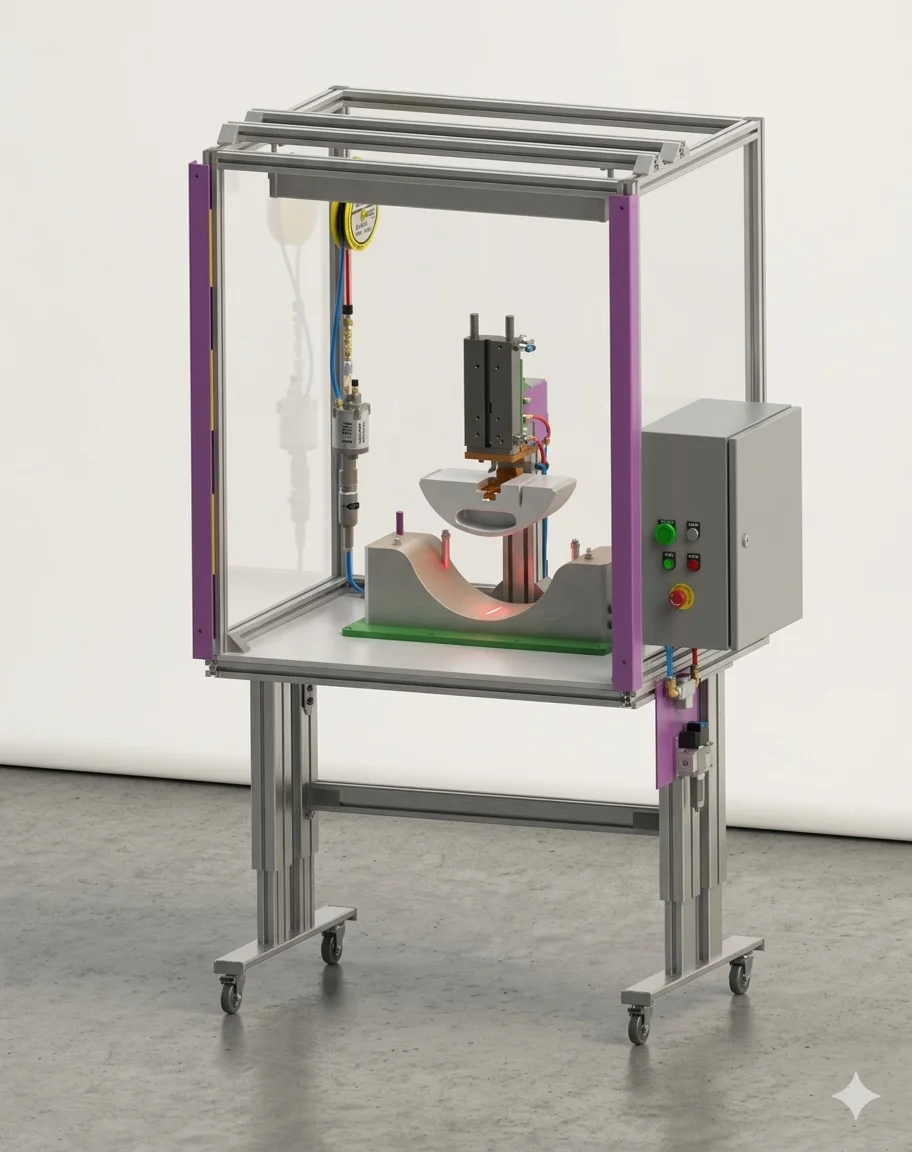
The safety chain of a press
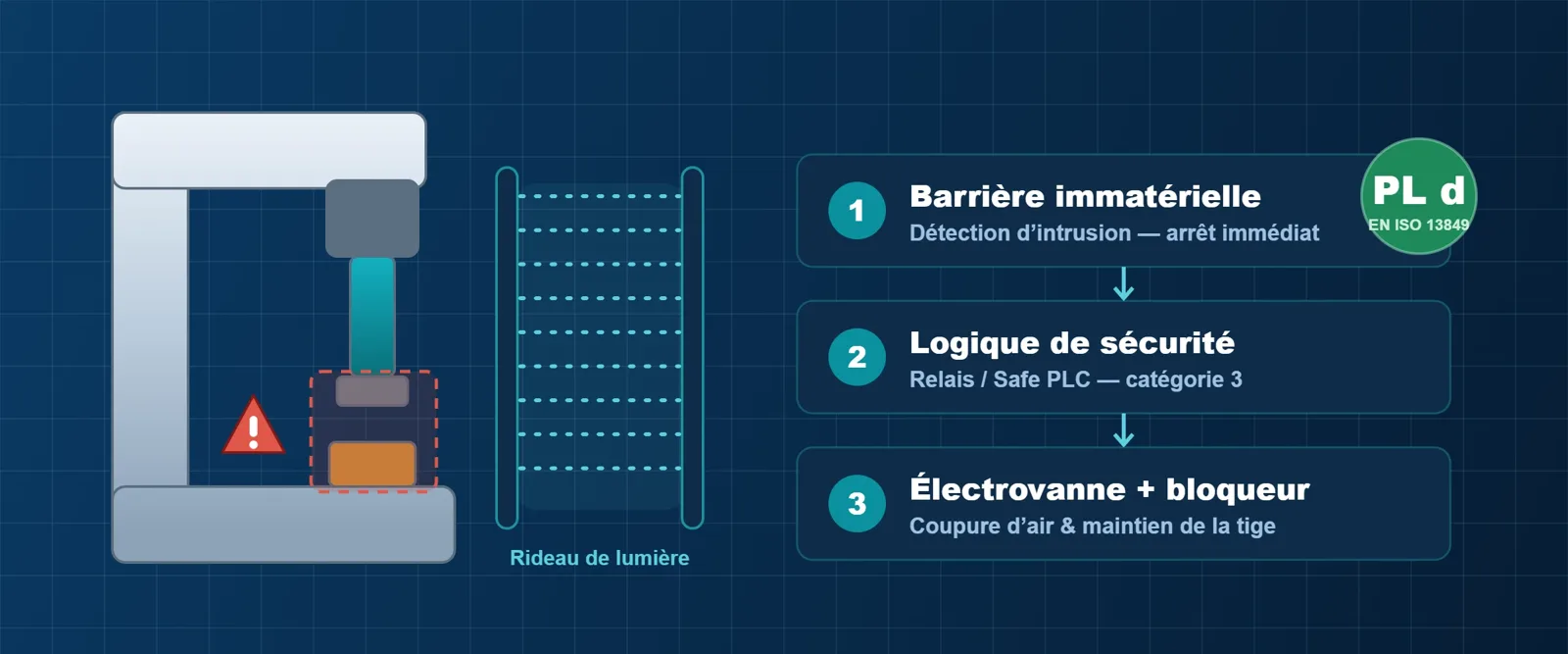
For guillotine-door presses, we favor an unattached cylinder that only handles the upstroke: the door comes back down by gravity after depressurization, for intrinsic safety. Balancers (gas springs or progressively damped cylinders) control the descent and prevent impact, noise and wear.
From specifications to CE file
- 01
Needs analysis
Operation, force, accuracy, traceability and throughput; selection of the press technology.
- 02
3D design and calculation
Frame, gooseneck, tooling and guides in SolidWorks; strength-of-materials calculation and deflection management.
- 03
Safety and actuators
Cylinder sizing, risk assessment, light curtains, SISTEMA analysis, solenoid valves and rod locks.
- 04
Manufacturing and commissioning
Workshop assembly, testing, safety wiring and relays, CE file.
Frequently asked questions
Pneumatic, oleo-pneumatic or electric: which technology to choose?
It depends on the force, the accuracy and the need for traceability. Pneumatic is suitable up to ~50 kN for simple operations; oleo-pneumatic reaches over 300 kN with a constant force; the electric servo press offers position to ±0.01 mm and native traceability, for medical or automotive components.
What is the deflection of a press?
It is the elastic deformation of the gooseneck frame under load, which moves the head away from the platen. It misaligns the tool and distorts the sensor reading. We calculate it by strength-of-materials analysis and aim for less than 0.1 mm in precision press-fitting, using S355 steel, hardened steel or SG cast iron depending on the requirement.
How is the distance of a light curtain calculated?
According to standard EN ISO 13855, using the formula S = K × T: S is the minimum distance in mm, K the approach speed (2,000 mm/s for the upper limbs) and T the total stopping time (light curtain response, safety relay and mechanical stop).
What is the SISTEMA analysis?
SISTEMA is IFA software that calculates the performance level (PL) achieved per standard EN ISO 13849, based on the category, MTTFd, DCavg and common-cause failures. The SISTEMA report is part of the CE file.
Why a cylinder rod lock?
A rod lock (rod brake) automatically clamps the rod as soon as pressure drops and holds the tool in position without compressed air. It prevents the tool from free-falling in the event of a cutoff and is factored into the SISTEMA calculation.
Do you handle CE compliance?
Yes. Risk assessment, SISTEMA analysis, selection of certified components and commissioning lead to a complete CE file, referenced to Machinery Directive 2006/42/EC.
A press to design?
Describe the operation, the force and the throughput to us: we size the press, study the safety and propose a preliminary design.
Send us your specifications
